Your practitioner
My story really begins with my own health.
For as long as I can remember, I was unwell, run down, depleted, my body constantly fighting something it could never quite win against. Relentless infections, raging fevers, debilitating coughs that left me drained for weeks - the kind of deep exhaustion and weakness that no amount of rest could touch. I lost count of the GP visits: the same waiting rooms, the same rushed appointments, the same outcome: another course of antibiotics, another "let's see how you go." Over the years, it ran into hundreds of prescriptions, two operations, months of waiting on lists, and still no real answer.
I did everything I was told. I took what I was given. And still, nothing changed. I'd start to feel better again, only to be knocked back down weeks later, sicker, weaker, more depleted than before. It was exhausting, not just physically, but the sheer helplessness of it. The feeling of being passed along, patched up, and sent away, while no one stopped to ask the one question I couldn't stop asking myself: why does this keep happening to me?
Why were we silencing symptoms and treating parts of me, but never once looking beneath it all, at why my body kept struggling in the first place, or how to actually restore it? Conventional medicine, for all it can do, never got to the root. And I was living proof.
It was during my Aalimiyyah studies that something first shifted. Six years immersed in the richness of our Islamic tradition: revered scholars, timeless texts, profound wisdom, and in those final years, I came across the chapters on tibb, our Islamic and Prophetic medicine. Something in me lit up. Here, in our books, fourteen hundred years ago, was a complete science of healing — the body, the mind, the heart and the soul, treated as one, never apart. I saw how the Qur'an and the Sunnah speak of shifāʾ as healing for the whole of us, for the body, and for what lies within the chest, the physical and the spiritual, never divided. But the more I studied it, the more I realised something painful: we had let it fade. This beautiful, sophisticated tradition, neglected and forgotten, and with it, a part of our very identity as Muslims.
That curiosity never left me. Through my health sciences degree, and in my own reading and courses long after lectures ended, I kept pulling the thread, and a whole world opened up.
I discovered the Muslim physicians of our golden age — the giants who shaped the very foundations of modern medicine. Ibn Sīnā (Avicenna), whose Canon of Medicine was studied in European universities for six hundred years. Al-Rāzī (Rhazes), who first distinguished one disease from another with astonishing clinical precision. Al-Zahrāwī (Albucasis), the father of surgery, whose instruments we still recognise today. Ibn al-Nafīs, who described the circulation of blood through the lungs four centuries before the West would claim it. And so many more, scholars and healers whose pioneering work built the very ground modern medicine stands on, yet whose names have been quietly written out of our textbooks and our history. These were believers, working from the Qur'an and Sunnah, who mapped the body, catalogued remedies, pioneered treatments, and understood health in ways the world would take centuries to catch up to.
And what moved me most was that they never treated the body alone. Over a thousand years ago, Abū Zayd al-Balkhī wrote of the Sustenance of the Soul — describing anxiety, obsessive thoughts and depression, and how to treat them, centuries before modern psychology claimed them as its own. Scholars like Al-Ghazālī, Ibn Taymiyyah, Ibn al-Qayyim and Imām al-Suyūtī wrote deeply on the heart, the soul, the nafs, and Prophetic medicine, mapping the inner world with the same care the physicians gave the body. Body and soul, medicine and meaning, never divided. This was their genius: they understood the human being as a whole.
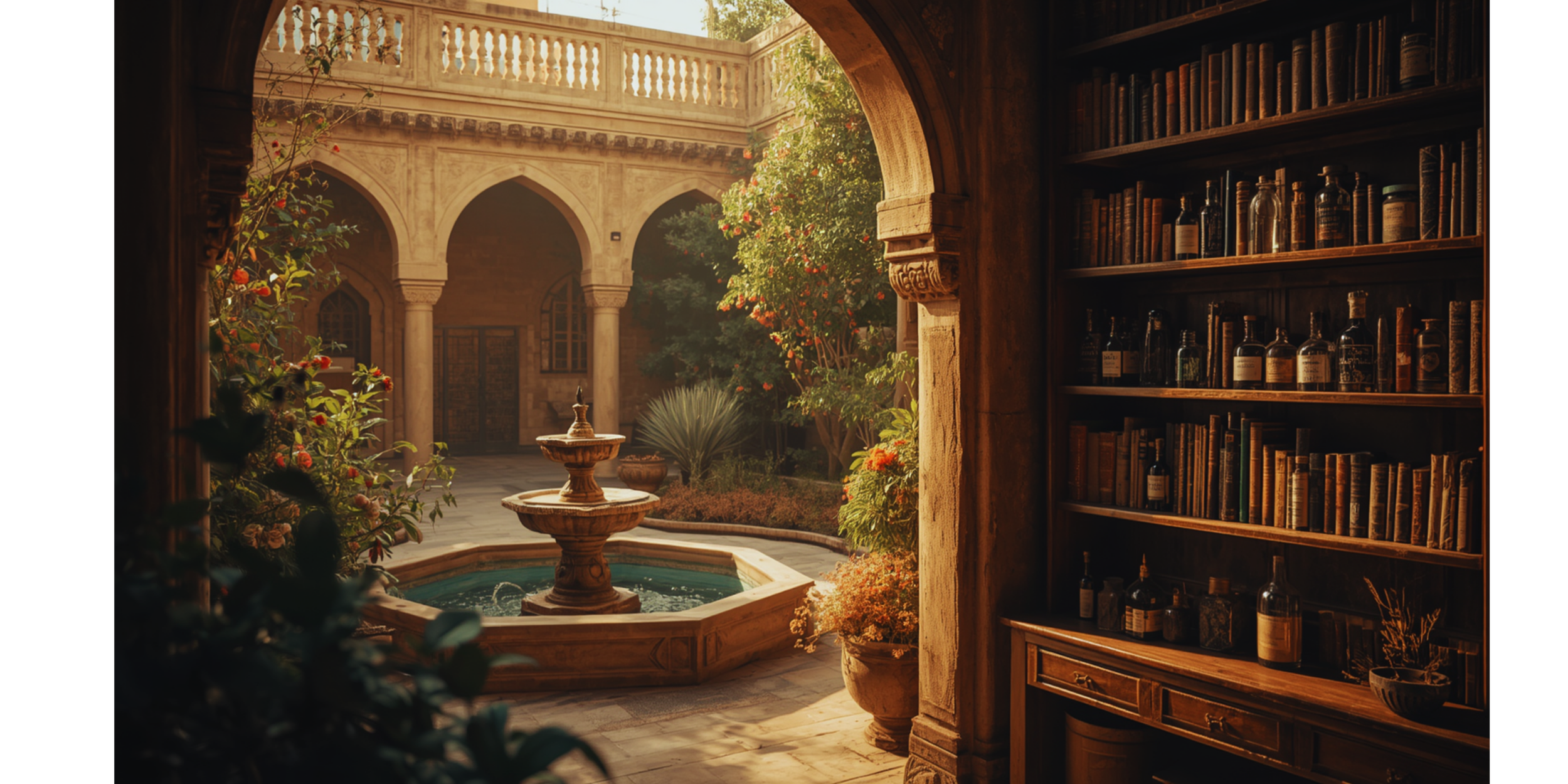
And it wasn't only their knowledge that struck me; it was how they healed. I learned about the bimaristans, the great hospitals of the Islamic world, centuries ahead of their time, built not as sterile wards but as places of true healing: arranged around open courtyards and gardens, cooled by running water and fountains, filled with the sounds of Qur'an and nature. Here, mental and emotional wellbeing were treated as seriously as physical illness, never apart from it, with patients cared for through diet, herbs, rest, and environment as much as medicine; the physical, the emotional and the spiritual cared for as one, with connection to Allah at the very centre. This was an integrated system of healthcare, whole-person medicine in its truest form. And it was ours. Extraordinary, and almost entirely forgotten.
Meanwhile, my degree was teaching me the science of the body, and I loved it. Human biology and physiology, the workings of cells and systems, the mechanisms of health and disease, public health, the brain and mental health, and the evidence behind how we treat it all. The precision of it, the way every symptom could be traced back to a biological process, the body as something that could be measured, mapped and explained. Modern medicine and health science are extraordinary; they name our conditions, decode our biology, and save lives every day.
But the longer I studied, the more I felt the edges of what science alone could reach. It was all surface. All body, no heart. We learned to name conditions and target symptoms, but never to ask what the whole person was carrying. And I saw it everywhere I looked: the woman exhausted no matter how she slept, the one whose bloods came back "normal" while she felt anything but, the stress and anxiety sitting beneath the symptoms, the quiet disconnect no test could ever name. Science could explain the what, but it struggled with the why. It could treat the body, but it fell silent on the heart, and it had nothing to say about the soul. And I couldn't unsee it, because I was that whole person the system had never truly seen.
And it wasn't only in myself, or in my studies, that I saw it. In the five years I spent working in clinical healthcare, I watched the same story repeat, in patient after patient. A symptom would appear, and a prescription would follow. Rarely was there a pause to ask why it had appeared at all, or whether it might be healed rather than only managed.
I watched medication become the first answer, and so often the only one. For chronic conditions like anxiety, diabetes and high blood pressure, a prescription was frequently written for life, with little conversation about nourishment, lifestyle, or the gentler remedies that might work alongside it. Seldom an alternative, seldom a complement, seldom a cause. And I began to wonder: is this truly healing, or only masking? Pharmaceutical medicine has its place, but I could not accept that it should so often be the first word, and the last, when Allah had placed so much more within our reach.
So I began to ask the questions that became Harakah Clinic:
Why do we silence the symptom, and never treat the root cause beneath it?
Why have we forgotten the wisdom of healing, and the remedies Allah placed in His creation — in nourishment, in nature, in the way we live?
And how can we seek true healing without caring for the heart and soul, and turning to ash-Shāfī, the One who heals?
Harakah Clinic is my answer, and I pray, part of reviving something we were never meant to lose.
I sit at a rare meeting point: a qualified Islamic scholar (Aalimiyyah) and hāfidhah of the Qurʾān, and a health sciences graduate (BSc Hons), with training in Islamic Psychology & Counselling, Lifestyle Medicine, Naturopathic Medicine, and Functional Medicine. Few practitioners can hold both the deen and the science with this fluency, and it's exactly this that lets me care for you as a whole being: body, heart and soul, the way our tradition always did.
WIth duas, Humaira…
Credentials & registrations
Aalimah & hāfidhah — qualified Islamic scholar and memoriser of the Qurʾān
BSc (Hons) Health Sciences
Registered and regulated by the General Regulatory Council for Complementary Therapies (GRCCT), the UK's Federal Regulator for complementary and integrative healthcare
Registered member of the Federation of Holistic Therapists (FHT), the UK’s leading professional body upholding rigorous standards of practice and ongoing professional development (CPD)
Fully insured integrative health practitioner
Qualified partner practitioner with accredited functional testing laboratories and herbal apothecaries